Cyber Incidents Require Technical Cooperation Before Legal Warfare: The Case for Emergency Mediation in Technology Contracts
October 5, 2026 · admin
A tiered response model for cyber incidents: technical cooperation first, expedited mediation if necessary, and binding proceedings only where required.
By A-Resolve Editorial Team
A major cyber incident rarely begins as a conventional legal dispute. A critical vulnerability is discovered. Systems may need to be isolated. Customers demand explanations. Regulators may need to be notified. Digital evidence must be preserved. The technology provider and its customer may disagree about what happened, who was responsible, or whether contractual obligations were breached.
Yet, at precisely the moment when their legal interests begin to diverge, the parties often remain technically dependent on one another. That creates an unusual dispute-resolution problem.
Traditional litigation or arbitration is designed to determine rights and liabilities. A cyber crisis, however, may require something more immediate: keeping the parties communicating long enough to contain the incident before the dispute itself becomes harder to resolve.
Recent international policy discussions suggest that this distinction deserves greater attention.
From cyber diplomacy to commercial disputes
In September 2026, Switzerland, acting as Chair of the Organization for Security and Co-operation in Europe (OSCE), hosted an international conference in Zug on **“De-escalation in Cyberspace: Mediation and Preventive Diplomacy.”**
The conference examined how cyber incidents can escalate when attribution is uncertain, trust deteriorates and communication breaks down. Participants considered whether mediation, secure channels of communication and other confidence-building mechanisms can preserve dialogue before a cyber incident develops into a wider conflict. The discussions also recognised the increasingly important role of private-sector and other non-state actors in identifying and managing cyber risks.
Although the conference focused primarily on international security and relations between states, the underlying logic applies equally well to private technology disputes.
Consider a SaaS provider whose software suffers a security incident affecting a corporate customer. The customer may suspect inadequate security controls. The provider may believe that the incident resulted from the customer's configuration or compromised credentials. A cloud provider, cybersecurity contractor or other subcontractor may also be involved.
Within hours, several questions can arise simultaneously.
Who controls the relevant logs? Who must investigate the incident? Can affected systems safely remain operational? Who communicates with regulators or customers? What information must be preserved? Does sharing technical material prejudice a later legal claim? And who bears the cost of emergency remediation?
At that stage, immediately turning every disagreement into an adversarial legal battle may make technical containment more difficult.
The weakness of conventional dispute clauses
Many technology agreements still contain a dispute-resolution provision designed principally for the final stage of a dispute. It typically specifies courts or arbitration, governing law and perhaps an obligation to negotiate before proceedings begin.
What it often does not provide is a process for the first 24 or 72 hours of a technology crisis.
That omission matters.
Cyber incidents develop at machine speed, while legal disputes develop at institutional speed. A contractual mechanism designed only to determine liability months later may do little to help parties who need to make coordinated decisions today.
A more effective technology contract can therefore distinguish between two questions.
The first is how the parties will manage the incident together. The second is how they will ultimately determine legal responsibility and damages. Those questions do not necessarily require the same procedure.
Why emergency mediation can help
Mediation is particularly suited to situations where parties remain commercially or technically interdependent.
Unlike a court or arbitral tribunal, a mediator does not normally impose a determination of fault. The process can instead help the parties agree on immediate operational measures while preserving their respective legal positions.
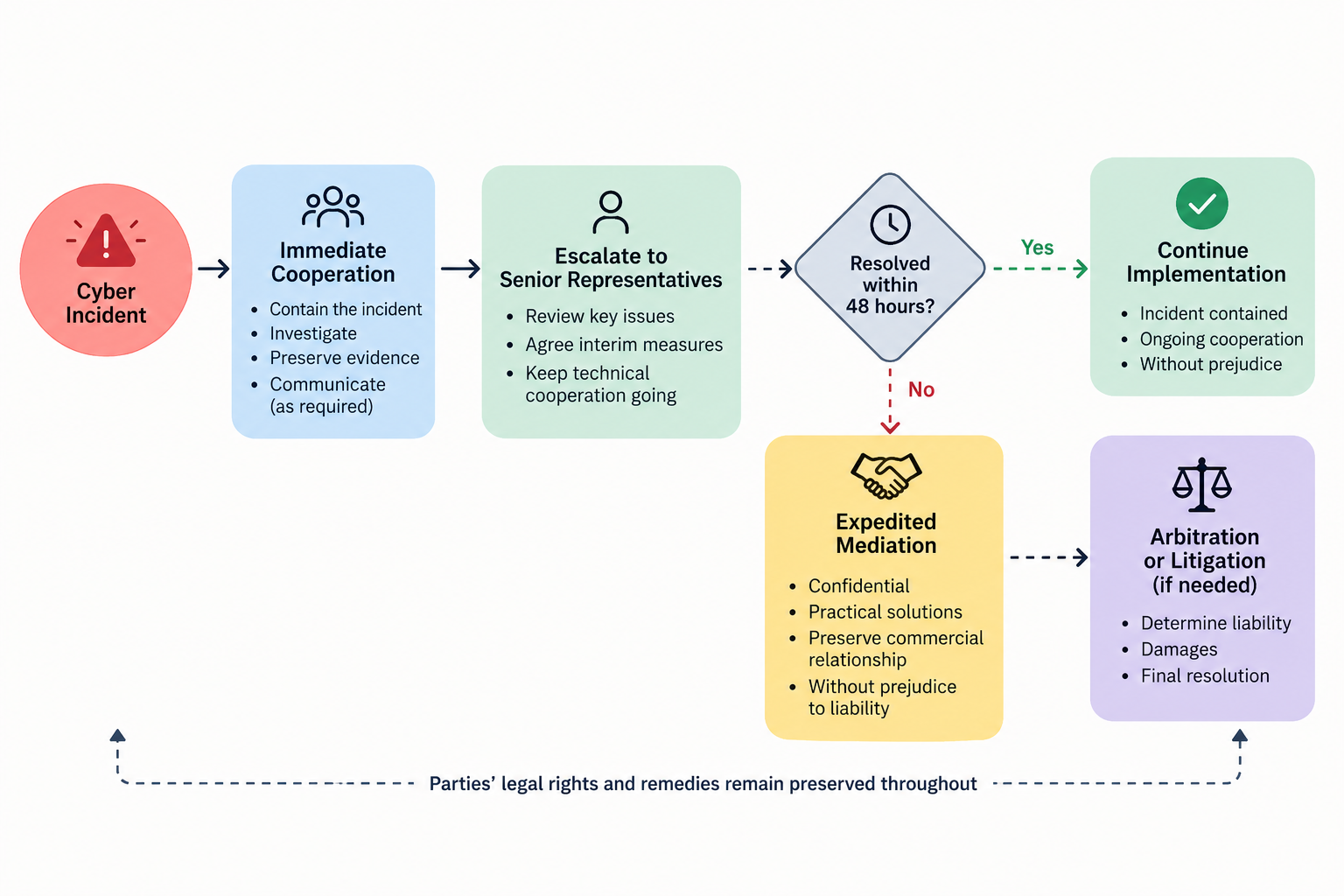
In a cyber dispute, that might include temporary arrangements concerning access to systems, preservation and exchange of logs, appointment of independent forensic experts, customer communications, remediation work or allocation of immediate costs.
The parties may expressly agree that these temporary arrangements are **without prejudice** to later arguments about liability.
That distinction can be commercially valuable. Cooperation necessary to restore systems should not automatically be interpreted as an admission that one party caused the incident.
Confidentiality is another advantage. Cyber disputes may involve security vulnerabilities, proprietary architecture, personal data, trade secrets and information that could create further risk if unnecessarily exposed.
WIPO's experience with international technology disputes similarly identifies confidentiality, procedural flexibility, specialist expertise and preservation of commercial relationships as important advantages of mediation. It also encourages the inclusion of mediation clauses in technology contracts before disputes occur.
Mediation does not replace arbitration or litigation
Emergency mediation should not be misunderstood as a substitute for binding dispute resolution.
Some cyber disputes will ultimately require a tribunal to determine causation, contractual breach, damages, indemnification or insurance responsibility. Emergency court or arbitral measures may also be necessary where assets, evidence or confidential information require immediate protection.
The better approach is therefore often **tiered dispute resolution**.
The contract can require immediate technical cooperation following a qualifying cyber incident, followed by rapid escalation to designated senior representatives. If material issues remain unresolved, the parties can attempt an expedited mediation within a very short period. Arbitration or litigation remains available if settlement cannot be achieved.
The purpose of mediation at this stage is not necessarily to settle the entire dispute.
It may simply prevent the dispute from interfering with incident containment.
For cross-border disputes, mediation also benefits from a developing international framework. The UNCITRAL Singapore Convention on Mediation provides an international mechanism for recognition and enforcement of qualifying international commercial settlement agreements in jurisdictions where the Convention applies.
Contract drafting should begin before the incident
The effectiveness of emergency mediation depends heavily on drafting.
A useful clause should define the events capable of triggering the procedure, identify representatives authorised to act quickly, preserve confidentiality and legal rights, and ensure that participation in emergency cooperation does not prevent either party from seeking urgent interim relief where genuinely necessary.
It should also recognise a practical reality: during a cyber crisis, technical personnel may need to cooperate even while lawyers dispute responsibility.
Contracts should enable both processes to occur simultaneously.
As cyber regulation increasingly imposes rapid notification, investigation and remediation obligations, technology agreements should therefore evolve beyond conventional liability clauses. The objective is not to eliminate disputes. It is to prevent an incident that could have been contained through cooperation from becoming a larger operational and legal crisis because the contract offered the parties no mechanism other than escalation.
Sample Emergency Cyber Incident Mediation Clause
A clause will always require adjustment to the governing law, transaction, regulatory environment and chosen dispute-resolution institution. As a starting point, parties may consider wording along the following lines:
*“Where a Cyber Incident materially affects, or is reasonably likely to materially affect, the services, systems, data or regulatory obligations of either Party, the Parties shall promptly cooperate in good faith to contain, investigate and mitigate the Incident and to preserve relevant evidence. Any dispute arising during such response that materially impedes containment or remediation shall be referred immediately to designated senior representatives of the Parties. If the matter is not resolved within 48 hours of such referral, either Party may request an expedited confidential mediation, to commence as soon as reasonably practicable. Participation in incident response, technical cooperation or mediation shall be without prejudice to either Party's rights, remedies or position as to liability and shall not constitute an admission of fault. Nothing in this clause prevents either Party from seeking urgent interim or conservatory relief where necessary to protect systems, data, evidence or legal rights. Any dispute not resolved through mediation shall be determined in accordance with the final dispute-resolution mechanism provided in this Agreement.”*
---
**Main References**
Swiss Confederation / Swiss OSCE Chairpersonship, *De-escalation in Cyberspace: Mediation and Preventive Diplomacy*, September 2026.
OSCE, *Chairpersonship Conference in Switzerland Highlights Preventive Diplomacy and Mediation to Reduce Risks of Escalation in Cyberspace*, 29 September 2026.
WIPO Arbitration and Mediation Center, *Mediation for IP and Technology Disputes*.
UNCITRAL, *United Nations Convention on International Settlement Agreements Resulting from Mediation (Singapore Convention on Mediation)*.
*This article is intended for general information and does not constitute legal advice.*
 A-Resolve