The Most Expensive Clause in a Technology Contract May Be the One Copied for Free
October 15, 2026 · admin
Different technology relationships require different governing-law and dispute-resolution architectures.
The Most Expensive Clause in a Technology Contract May Be the One Copied for Free
Designing Governing-Law and Dispute-Resolution Clauses for Technology and Startup Contracts
By A-Resolve Editorial Team
Technology contracts often devote pages to services, payment, data, security, intellectual property and limitation of liability. The provisions governing a future dispute may receive only a few minutes. A familiar clause is copied from another agreement, a jurisdiction is inserted, and the contract is signed.
That shortcut may be inexpensive when it is made. It can become exceptionally costly when the relationship fails.
A dispute-resolution clause is not merely the contract’s exit sign. It is its emergency plan. It determines who may decide a dispute, under which procedural framework, with what access to interim measures, and whether the eventual outcome can reach the relevant company, counterparty or assets. Those questions cannot be answered adequately without considering the commercial and technological context of the transaction.
This article offers a practical framework for designing that architecture. It does not prescribe a universal clause. Its central proposition is the opposite: one clause does not fit every technology contract.
“Governing law” is not a complete dispute strategy
The sentence “This agreement is governed by the laws of…” answers an important question, but only one question. A workable dispute architecture may require at least four separate decisions:
1. The law governing the substantive contract. This ordinarily determines how contractual rights, obligations, breach and remedies are analysed.
2. The forum or dispute mechanism. The parties must decide whether disputes go to national courts, arbitration, mediation, expert determination or a structured combination of processes.
3. The arbitral seat and the law governing the arbitration agreement. Where arbitration is selected, the juridical seat connects the proceeding to a national arbitration law and supervisory courts. The law governing the arbitration agreement may also require separate attention.
4. Recognition and enforcement. A judgment, award or settlement is commercially useful only if it can be recognised and enforced where the relevant counterparty or assets are located.
These elements interact, but they are not interchangeable. ICC guidance accordingly recommends considering not only the law governing the contract, but also the place and language of arbitration and the law governing the arbitration agreement. It also warns that unclear drafting can create uncertainty, delay and even compromise the process.[1]
The enforcement question should not be postponed until a dispute exists. The New York Convention provides an international framework for recognising arbitration agreements and enforcing foreign and non-domestic arbitral awards, but it does not eliminate the need to consider the law and practical conditions in likely enforcement jurisdictions.[2] The UNCITRAL Model Law likewise addresses the arbitral process from the arbitration agreement and tribunal jurisdiction through interim measures and enforcement, while domestic enactments may differ.[3]
The correct starting point is therefore not: “Which model clause should be copied?” It is: “What must this dispute process be capable of doing?”
B2B platforms and technology-service contracts
In a B2B platform, SaaS, cloud or technology-services relationship, a dispute may develop while the parties remain operationally dependent on each other. The customer may need continued access to systems and data. The provider may need payment, cooperation and protection against uncontrolled changes. Both sides may need engineers to preserve logs, isolate an incident or maintain business continuity.
A conventional clause that moves every disagreement directly into a single adjudicatory process may be too blunt. The contract may instead need to distinguish among different categories of issue:
- operational incidents requiring immediate technical cooperation;
- technical questions suitable for an independent expert;
- commercial disagreements capable of negotiated or mediated resolution;
- urgent matters requiring interim relief; and
- claims requiring a final and binding determination.
A multi-tier process can be valuable when its stages, triggers and time limits are precise. For example, operational issues may first be escalated to authorised senior representatives; defined technical questions may go to expert determination; a short mediation window may follow; and unresolved legal claims may proceed to arbitration or litigation. WIPO’s recommended clauses expressly recognise combinations such as mediation followed by expedited arbitration, mediation followed by expert determination, and expert determination followed by arbitration.[4]
The purpose is not to create procedural obstacles. It is to keep a technical disagreement from unnecessarily destroying a functioning commercial relationship.
B2C platforms: consent is not the end of the analysis
A platform cannot assume that a dispute clause becomes effective merely because a user clicked “Accept”. Consumer relationships are subject to mandatory rules that may restrict party autonomy, choice of law, jurisdiction and arbitration.
Within the European Union, Article 6 of the Rome I Regulation permits a choice of law in qualifying consumer contracts, but the choice cannot deprive the consumer of protections that would otherwise apply and cannot be derogated from by agreement.[5] The Brussels I Recast contains protective jurisdiction rules for consumer contracts.[6] The Unfair Terms Directive treats non-negotiated terms as potentially unfair where they create a significant imbalance to the consumer’s detriment; its indicative list includes terms that improperly hinder legal remedies or require certain forms of exclusive arbitration.[7]
The practical consequence is significant. A clause suitable for two sophisticated technology companies may be ineffective, unfair or commercially inappropriate when inserted into consumer terms of service. A B2C platform should examine, among other matters:
- where its users are habitually resident;
- whether it directs activities to those jurisdictions;
- which consumer protections are mandatory;
- whether the clause is transparent and intelligible;
- whether the process imposes disproportionate cost, travel or procedural burdens; and
- whether users retain access to remedies that cannot lawfully be excluded.
The B2C analysis must therefore begin with mandatory consumer law, not with a preferred arbitral institution or governing-law label.
Founder, shareholder and investment agreements
Startup disputes rarely fit neatly into an ordinary supplier-customer model. A disagreement among founders or investors may affect voting rights, board control, access to accounts, intellectual-property ownership, vesting, further fundraising and the continued operation of the company.
Here, the dispute clause must be read together with the company’s place of incorporation, constitutional documents, shareholders’ agreement, investment documents, employment or service agreements, and intellectual-property assignments. Inconsistent clauses across that document set can produce satellite disputes about which forum should decide the real dispute.
The drafting process should test at least five questions:
1. Can urgent relief be obtained before control, assets or confidential information are irreversibly affected?
2. Should valuation, accounting or technical questions be referred to an independent expert rather than decided as ordinary legal claims?
3. Can related disputes under several transaction documents be consolidated or heard together?
4. Are all necessary parties bound by compatible dispute provisions?
5. Will confidentiality, document preservation and business continuity be protected while the dispute proceeds?
The objective is not simply to identify a tribunal. It is to prevent the dispute process itself from becoming another source of corporate paralysis.
Web3, trading and crypto-service contracts
Web3 and digital-asset transactions make the limitations of boilerplate particularly visible. The parties may be incorporated, resident or operational in different jurisdictions. A service may be provided through decentralised infrastructure. Relevant conduct may be recorded on-chain, while private communications, custody arrangements and identity evidence remain off-chain. Assets may move quickly and may be held through intermediaries or wallets whose legal treatment varies.
The UNIDROIT Principles on Digital Assets and Private Law illustrate the need for a functional and cross-border analysis. They address matters including control, transfers, custody, secured transactions, insolvency, enforcement and applicable-law questions, while recognising that other domestic and regulatory laws continue to matter.[8]
A Web3 or crypto dispute clause should therefore be tested against the actual transaction architecture:
- Who are the legally identifiable parties?
- What contractual and non-contractual claims fall within the clause?
- Where are custodians, intermediaries and relevant assets located?
- What evidence exists on-chain, and what evidence depends on off-chain systems or individuals?
- Which regulatory, insolvency, sanctions or consumer rules may be mandatory?
- Which court or tribunal can grant effective urgent measures?
- Where is an award or judgment likely to require enforcement?
Selecting a technologically fashionable mechanism is not enough. The process must connect legal authority to the people, entities, systems and assets that can make the outcome effective.
From a model clause to a dispute architecture
Institutional model clauses are valuable starting points. They reduce drafting ambiguity and help parties refer disputes to a recognised procedural framework. They are not, however, substitutes for transaction-specific analysis.
WIPO’s survey of technology transactions found that 94 per cent of respondents treated negotiation of dispute-resolution clauses as part of contract negotiations. Cost and time were leading considerations, while enforceability and forum neutrality carried greater weight in international agreements.[9] Those findings reinforce a practical point: dispute design is a commercial decision as well as a legal one.
Before finalising the clause, the parties should work through the following checklist:
A practical drafting checklist
1. Map the relationship. Identify the parties, users, group companies, subcontractors, intermediaries and jurisdictions that may become relevant.
2. Classify likely disputes. Separate technical, operational, payment, IP, data, ownership, regulatory and consumer issues.
3. Protect the first 24–72 hours. Decide how systems, evidence, assets, communications and business continuity will be preserved before final liability is determined.
4. Match the process to the issue. Consider negotiation, technical escalation, mediation, expert determination, expedited arbitration, ordinary arbitration and court proceedings according to function—not habit.
5. Draft the sequence precisely. If the clause is multi-tiered, define when each stage begins, how long it lasts, who participates and when a party may proceed to the next stage.
6. Align the legal layers. Address substantive governing law, forum, arbitral seat, procedural rules, language and—where appropriate—the law governing the arbitration agreement.
7. Test mandatory rules. Examine consumer, employment, company, insolvency, financial-services, sanctions, data-protection and regulatory constraints that cannot simply be excluded by contract.
8. Work backwards from enforcement. Identify where counterparties and assets are likely to be located and ask whether the chosen outcome can operate there.
9. Align all transaction documents. Avoid contradictory clauses across master agreements, statements of work, terms of service, shareholder documents, side letters and IP assignments.
10. Revisit the clause when the business model changes. New markets, users, custody structures, regulated activities or group entities can make an earlier dispute design obsolete.
Conclusion
The most dangerous dispute clause is not necessarily the clause that looks obviously defective. It may be the polished clause that was drafted for a different transaction.
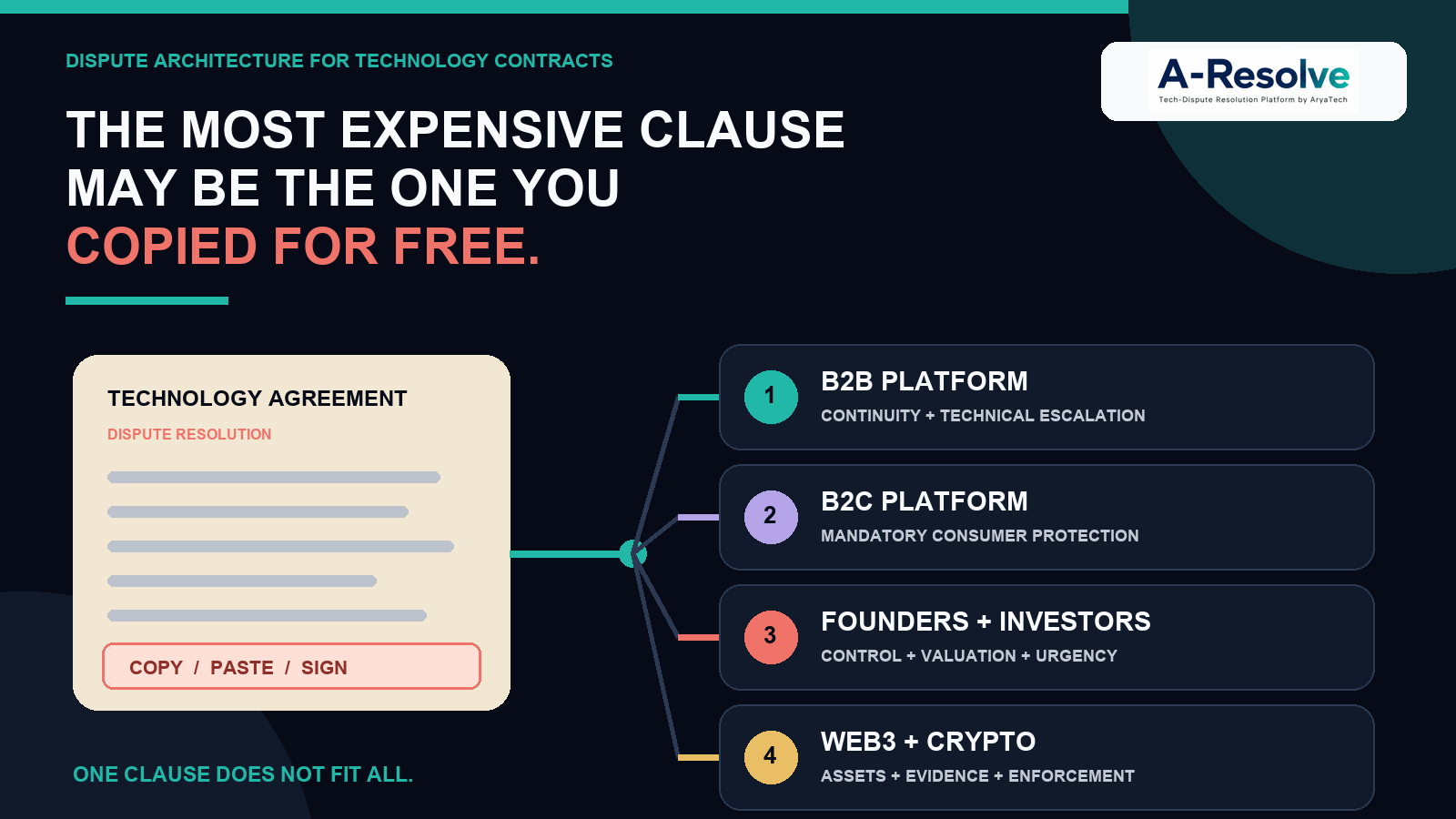
A B2B platform may need service continuity and technical escalation. A B2C platform must respect mandatory consumer protections. A founder or investment agreement must account for control, valuation and urgent relief. A Web3 arrangement must connect cross-border legal authority with digital evidence and assets.
The clause should therefore be designed from the dispute backwards: what could fail, what must continue, what must be preserved, who should decide each issue, and where the outcome must ultimately operate.
One clause does not fit every technology contract. The right dispute architecture begins with context.
This article provides general information and does not constitute legal advice. Applicable rules and enforceability depend on the contract, the parties and the jurisdictions involved.
References
[1] International Chamber of Commerce, “Arbitration Clause”, recommendations concerning governing law, place, language, law of the arbitration agreement and enforceability: https://iccwbo.org/dispute-resolution/dispute-resolution-services/arbitration/rules-procedure/arbitration-clause/
[2] United Nations Commission on International Trade Law, Convention on the Recognition and Enforcement of Foreign Arbitral Awards (New York, 1958): https://uncitral.un.org/en/texts/arbitration/conventions/foreign_arbitral_awards
[3] UNCITRAL Model Law on International Commercial Arbitration (1985), with amendments adopted in 2006: https://uncitral.un.org/en/texts/arbitration/modellaw/commercial_arbitration
[4] WIPO Arbitration and Mediation Center, Recommended Contract Clauses and Submission Agreements: https://www.wipo.int/en/web/amc/clauses/index
[5] Regulation (EC) No 593/2008 on the law applicable to contractual obligations (Rome I), Article 6: https://eur-lex.europa.eu/eli/reg/2008/593/oj/eng
[6] Regulation (EU) No 1215/2012 on jurisdiction and the recognition and enforcement of judgments in civil and commercial matters (Brussels I Recast), Articles 17–19: https://eur-lex.europa.eu/legal-content/EN/TXT/?uri=CELEX:32012R1215
[7] Council Directive 93/13/EEC on unfair terms in consumer contracts, Articles 3–6 and Annex 1(q): https://eur-lex.europa.eu/legal-content/en/TXT/?uri=CELEX:31993L0013
[8] UNIDROIT, Principles on Digital Assets and Private Law (2023): https://www.unidroit.org/instruments/digital-assets-and-private-law/overview/
[9] WIPO Arbitration and Mediation Center, Results of the International Survey on Dispute Resolution in Technology Transactions: https://www.wipo.int/amc/en/center/survey/results.html
 A-Resolve