When the Deal Breaks: Why SaaS, Platform, Founder and Web3 Contracts Need Different Dispute Paths
October 22, 2026 · admin
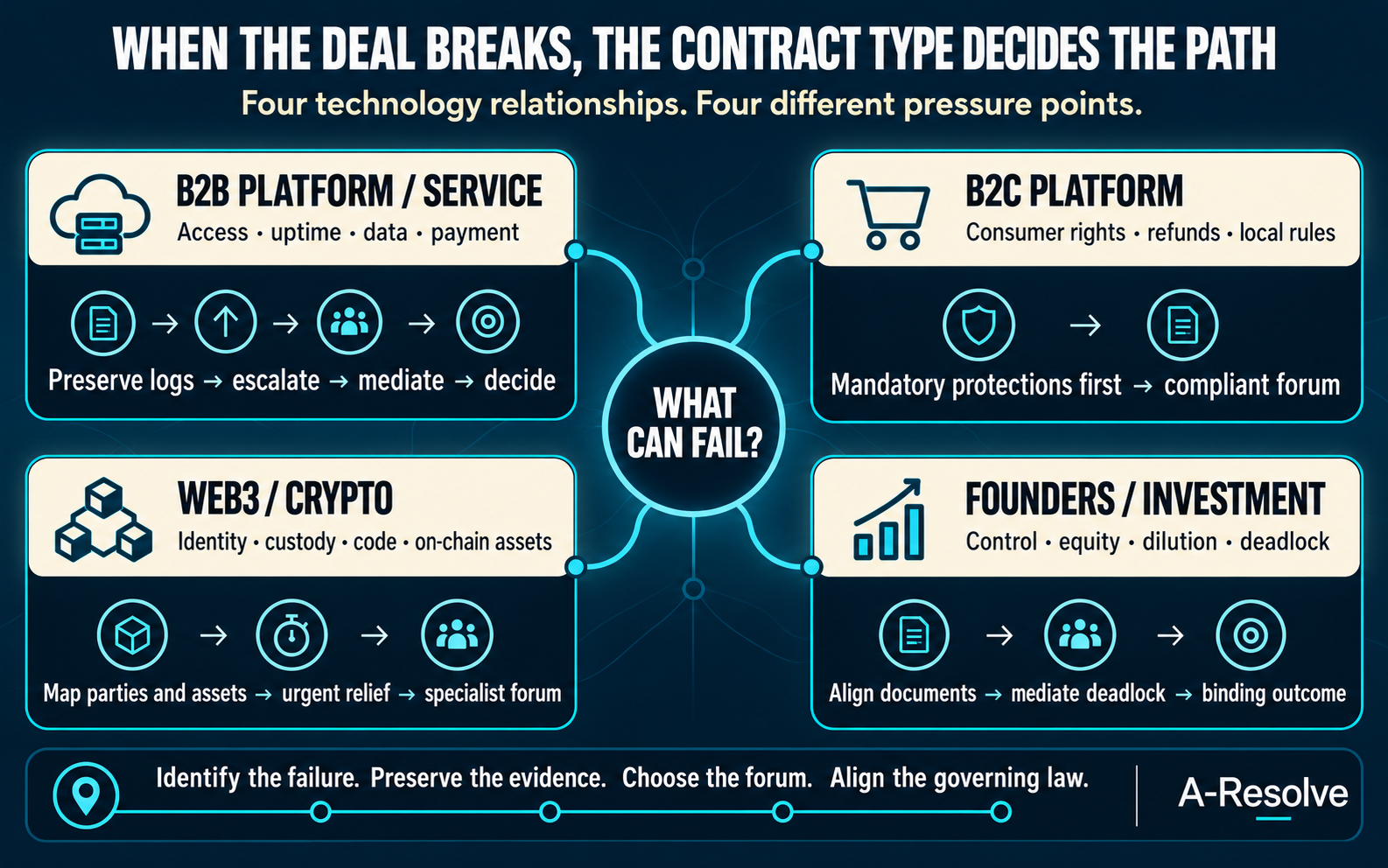
When the deal breaks, the contract type decides the path.
By A-Resolve Editorial Team
Technology contracts often end with the same familiar sequence: governing law, negotiation, mediation, arbitration or litigation. The wording may appear polished, balanced and legally complete. Yet the real test of a dispute clause is not whether it names a respectable institution or a recognised governing law. It is whether the clause protects the commercial relationship that actually exists.
A SaaS outage, a platform-account suspension, a founder deadlock and a frozen digital wallet are not variations of the same problem. Each threatens a different asset. Each develops at a different speed. Each requires access to different evidence and may call for a different form of urgent relief. Treating them as interchangeable can leave a business with an apparently valid clause that becomes practically useless at the moment it is needed.
The better starting question is therefore not, “Should we choose arbitration or courts?” It is: WHAT MUST SURVIVE WHILE THIS DISPUTE IS BEING RESOLVED?
SAAS: SERVICE AND DATA MUST SURVIVE
In a SaaS relationship, the immediate commercial risk is rarely confined to the eventual damages claim. The customer may depend on continuous access to the service, operational data, integrations and export tools. The provider may depend on payment, reasonable use of infrastructure and protection against security or compliance risks.
The dispute process should reflect that operational dependency. Before a claim moves toward a final decision, the contract may need a rapid technical escalation between named representatives, a process for preserving logs and configuration records, rules governing continued access or controlled data export, and a mechanism for allocating interim operating costs without treating payment as an admission of liability.
A clause that simply sends every disagreement to a tribunal may eventually determine who was right. It may do nothing to prevent the customer’s operations or the provider’s infrastructure from deteriorating during the case.
PLATFORMS: USERS AND TRUST MUST SURVIVE
Platform relationships are structurally different. A platform may connect businesses with customers, creators with audiences, sellers with buyers or developers with an ecosystem. One decision to restrict an account, remove content or change access can affect several relationships at once.
The dispute architecture should distinguish internal review, user-facing complaint procedures, urgent commercial escalation and the forum for binding claims. It must also account for mandatory legal protections that contractual language cannot simply displace. In the European context, for example, the Digital Services Act creates internal complaint and certified out-of-court settlement routes for certain platform decisions, while the Platform-to-Business Regulation addresses complaint handling and mediation for covered business users. Consumer contracts may also remain subject to mandatory protections despite a contractual choice of law.
For a platform, trust is part of the asset being protected. A technically enforceable clause can still be commercially damaging if it is opaque, inaccessible or disproportionate for the users expected to accept it.
FOUNDER AND INVESTMENT AGREEMENTS: CONTROL AND IP MUST SURVIVE
A founder dispute is not an ordinary supplier disagreement. The parties may simultaneously be shareholders, directors, employees, inventors and administrators of critical accounts. The immediate issue may be who can sign for the company, approve expenditure, communicate with investors, access source code or use intellectual property created before incorporation.
The dispute clause must work together with the shareholders’ agreement, articles, board rules, investment documents, employment arrangements and IP assignments. If those documents use conflicting laws, forums or escalation mechanisms, the procedure can become a second corporate crisis.
This context often requires careful treatment of deadlock, interim governance, preservation of access credentials and confidential information, and the authority to seek urgent protective measures. A final award issued months later may be of limited value if the company lost its product, funding opportunity or decision-making capacity in the meantime.
WEB3 AND DIGITAL-ASSET RELATIONSHIPS: ASSETS AND ACCESS MUST SURVIVE
Web3 arrangements add another layer. Relevant events may occur partly on-chain and partly off-chain. Control may depend on private keys, multisignature arrangements, administrator privileges, custody structures, governance votes or the practical identity of the person able to move an asset.
The governing law and dispute forum still matter, but they cannot be selected in isolation from operational control. The contract should identify the legal parties, the off-chain obligations accompanying smart-contract activity, the records that will evidence authority and consent, and the steps available when an asset or credential must be preserved urgently.
An award can travel through the international enforcement framework more readily than an informal promise, but an award does not automatically recover an anonymous counterparty, reconstruct a lost key or reverse an irreversible transaction. The legal process must connect to the people, systems and assets that can implement the outcome.
GOVERNING LAW AND FORUM PERFORM DIFFERENT JOBS
These examples also explain why governing law and dispute resolution should not be treated as one interchangeable choice. Governing law identifies the legal rules used to interpret rights and obligations. The forum clause determines where and by what procedure a dispute will be heard. The seat of arbitration supplies the procedural legal framework for an arbitration. Enforcement asks whether the resulting judgment, award or settlement can produce an effective outcome where the counterparty or assets are located.
International arbitration can offer neutrality and an established cross-border enforcement framework under the New York Convention. Mediation can preserve commercial relationships and produce tailored arrangements, with the Singapore Convention supporting enforcement of qualifying international mediated settlements among its parties. Courts may remain necessary or preferable for particular remedies, parties or statutory claims. None of these routes is inherently superior in every technology contract.
A PRACTICAL DRAFTING SEQUENCE
Before selecting a forum, the parties should map the failure scenario from the commercial facts backwards. What could stop first? What must continue? Who controls the relevant system, data, account, company decision or asset? Which evidence could disappear? Is a temporary operational arrangement needed before liability can be decided? Where are the counterparty and enforceable assets likely to be?
Only then should the contract allocate escalation, emergency measures, mediation, expert determination, arbitration or litigation. The process should match the speed and structure of the risk. It should also remain understandable to the people expected to use it under pressure.
The practical lesson is simple. A dispute clause should not be copied merely because the language looks standard. It should be designed around the asset whose loss would make a later legal victory irrelevant.
This article provides general information and does not constitute legal advice. The appropriate structure depends on the applicable law, parties, jurisdiction and transaction.
SELECTED PRIMARY REFERENCES
• UNCITRAL, Convention on the Recognition and Enforcement of Foreign Arbitral Awards (New York, 1958): https://uncitral.un.org/en/texts/arbitration/conventions/foreign_arbitral_awards.
• UNCITRAL, United Nations Convention on International Settlement Agreements Resulting from Mediation (Singapore Convention on Mediation, 2018): https://uncitral.un.org/en/texts/mediation/conventions/international_settlement_agreements.
• Regulation (EU) 2022/2065, Digital Services Act: https://eur-lex.europa.eu/eli/reg/2022/2065/oj, particularly Articles 20 and 21.
• Regulation (EU) 2019/1150 on fairness and transparency for business users of online intermediation services: https://eur-lex.europa.eu/eli/reg/2019/1150/oj, particularly Articles 11 and 12.
• Regulation (EC) 593/2008 on the law applicable to contractual obligations (Rome I): https://eur-lex.europa.eu/eli/reg/2008/593/oj, particularly Article 6.
• ICC, Arbitration Clause: https://iccwbo.org/dispute-resolution/dispute-resolution-services/arbitration/rules-procedure/arbitration-clause/.
• WIPO, Recommended Contract Clauses and Submission Agreements: https://www.wipo.int/en/web/amc/clauses/index.
• A-Resolve Arbitration Rules: https://www.a-resolve.com/arbitration/public/pages/arbitration-rules.php.
 A-Resolve