One Clause, Three Routes: How to Send Technical, Commercial and Legal Disputes to the Right Decision-Maker
October 29, 2026 · admin
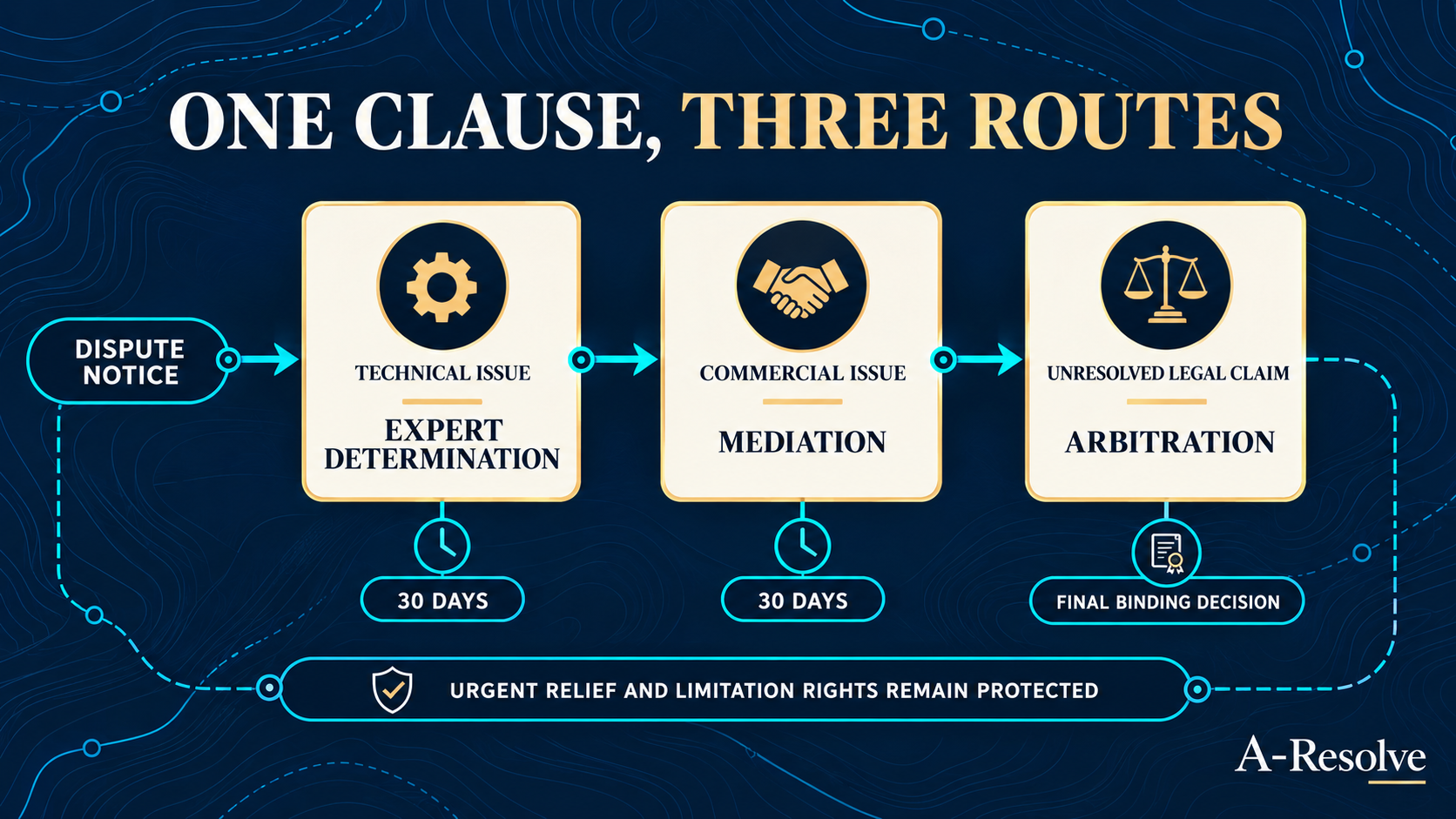
One clause can direct technical, commercial and legal issues through three connected and time-limited routes.
By A-Resolve Editorial Team
A practical reconstruction of a technology dispute clause using expert determination, mediation and arbitration.
A complex technology contract can produce several kinds of disagreement at the same time. The parties may disagree about whether software met its technical specification, whether the commercial relationship can continue, and whether one party has legally breached the agreement. Sending every issue immediately to the same decision-maker may be inefficient and, in some cases, destructive.
The better approach is not simply to add more dispute-resolution methods to the contract. It is to assign each type of issue to the process best equipped to resolve it, place those processes in a clear sequence, and give every stage a deadline. That structure can allow a technical question to be answered quickly, a commercial relationship to be renegotiated where possible, and only the unresolved legal claims to reach a binding tribunal.
This article reconstructs a multi-stage clause for a complex technology agreement. The model is aligned with the functional approach reflected in the A-Resolve Model Clauses and Rules. It is an illustration, not a universal clause. The wording must always be adapted to the contract, applicable law, parties and transaction.
WHY A GENERIC CLAUSE OFTEN FAILS
A familiar clause may say that the parties will negotiate in good faith, then mediate, and finally arbitrate. It sounds complete, but several important questions remain unanswered.
What happens when the disagreement is primarily technical? How long must the parties negotiate before moving forward? Is mediation genuinely required or merely optional? Can one party delay arbitration by refusing to participate in an earlier stage? Does the expert decide legal liability or only the defined technical question? Is the expert's answer binding? When can urgent court or emergency relief be requested?
If the clause does not answer these questions, the parties may begin by arguing about the procedure rather than the underlying problem. A multi-stage clause must therefore be more than a list of processes. It needs defined categories, triggers, time limits and a clear route to the final binding stage.
ONE DISPUTE MAY CONTAIN THREE DIFFERENT QUESTIONS
Consider a software implementation agreement. A system has failed to meet performance expectations, milestone payments have stopped, and the customer wants to terminate the project.
The technical question may be whether the system complied with the agreed specification, service level or acceptance criteria. An independent expert can often answer that question more efficiently than a full arbitral tribunal.
The commercial question may be whether the parties can agree on remediation, revised milestones, a price adjustment, a controlled transition or an orderly exit. A mediator can help them negotiate, but does not impose the solution.
The legal question may be whether the contract was breached, whether termination was valid, who bears liability and what remedy should be awarded. If the parties cannot settle, that question requires a final and binding decision through arbitration or another agreed adjudicatory forum.
The clause should recognise these differences from the start.
ROUTE ONE: TECHNICAL ISSUES GO TO EXPERT DETERMINATION
Expert determination is useful when the dispute turns on a defined technical, accounting, valuation or industry-specific question. In a technology contract, this may include conformity with specifications, completion of a milestone, system performance, source-code quality, calculation of service credits, valuation of work completed, or the cause of a technical failure.
The expert's mandate must remain precise. The parties should agree Terms of Reference identifying the question, documents, methodology, timetable, confidentiality obligations and the intended effect of the determination. The clause should state whether the determination is binding, non-binding, or binding only for a defined purpose or subsequent stage.
A technical expert should not be given an undefined power to decide the entire legal dispute unless the parties deliberately choose that structure. The expert can establish the technical fact on which the next discussion depends, while questions of contractual liability and legal remedy remain for settlement or arbitration.
The timetable should be short. A clause may require the Terms of Reference to be settled within seven business days and the determination to be issued within 30 calendar days, subject only to a limited extension where the expert reasonably requires it. Without a deadline, the first stage can become another source of delay.
The technical answer may itself resolve the dispute. If it does not, it gives the parties a reliable foundation for the next stage.
ROUTE TWO: COMMERCIAL ISSUES GO TO MEDIATION
Once the technical position is clearer, the remaining problem may be commercial rather than purely legal. The parties may need to decide whether the project continues, how remediation will be funded, whether milestones should change, how data will be transferred, or whether the relationship should end by agreement.
Mediation is designed for that conversation. The mediator does not determine who wins. The mediator helps the parties test options, understand risk and build an agreed solution that a tribunal might not have the power to impose.
If mediation is a required step, the contract should make that requirement practical. It should state when mediation begins, who must attend, and when the stage ends. Requiring at least one substantive session can prevent a party from satisfying the clause through a nominal invitation with no real engagement.
The mediation stage must also have an end point. For example, it may begin within five business days after the expert determination, or after the deadline for that determination expires, and terminate no later than 30 days after the mediator's appointment unless the parties agree in writing to continue. If there is no technical issue, the dispute can proceed directly to mediation.
The purpose of the deadline is not to rush a viable settlement. It is to ensure that mediation remains an opportunity rather than a veto over the final process.
ROUTE THREE: UNRESOLVED LEGAL CLAIMS GO TO ARBITRATION
If expert determination and mediation do not resolve the dispute, the unresolved legal claims proceed to arbitration. This is the stage that provides the final binding decision.
The arbitration provision should not be left as a vague reference to arbitration. It should identify the applicable rules, the juridical seat, the language, and whether the tribunal consists of one or three arbitrators. The seat connects the proceeding to a national arbitration law and supervisory courts. The number of arbitrators affects cost, speed and the way expertise is distributed across the tribunal. The governing law of the contract should normally be addressed separately and coordinated with the dispute clause.
The clause should also clarify that completion or expiry of the earlier stages is sufficient to unlock arbitration. A party should not be able to block the process by refusing to appoint an expert, failing to attend mediation or withholding agreement on procedural details. The contract can provide that if a required appointment or step is not completed within the stated time, the other party may proceed to the next stage.
URGENT RIGHTS MUST REMAIN PROTECTED
A staged process should not prevent urgent action where delay would cause serious harm. Technology disputes can involve threatened misuse of source code, movement of digital assets, loss of access credentials, destruction of evidence, disclosure of confidential information, service interruption or expiry of a limitation period.
The clause should therefore preserve the right to seek urgent interim or conservatory relief from a competent court, emergency arbitrator or tribunal, where available. It should also protect the ability to commence proceedings when necessary to preserve a claim, while allowing the staged process to continue for the substantive dispute.
A MODEL MULTI-STAGE STRUCTURE
The following wording illustrates the architecture. It should be reviewed and adapted before use.
1. DISPUTE NOTICE AND CLASSIFICATION
A party shall give written notice describing the dispute, the relief sought and whether the matter is said to concern a technical issue, a commercial issue, a legal claim, or a combination of them. Within five business days, authorised representatives shall meet to confirm the issues and the applicable route. A failure to agree on classification shall not prevent the process from continuing.
2. EXPERT DETERMINATION OF TECHNICAL ISSUES
Any defined technical, performance, accounting, valuation or industry-specific question shall first be referred to expert determination under the A-Resolve Expert Determination Rules. The parties and the expert shall settle the Terms of Reference within seven business days of appointment. Unless the Terms of Reference provide otherwise, the expert shall issue a reasoned determination within 30 calendar days. The Terms of Reference shall state whether, and for what purpose, the determination is binding. Questions of contractual liability and legal remedy remain reserved for settlement or arbitration unless expressly included in the expert's mandate.
3. MANDATORY MEDIATION OF UNRESOLVED COMMERCIAL ISSUES
Any issue not resolved by expert determination, and any dispute that does not require expert determination, shall be referred to mediation under the A-Resolve Mediation Rules. The mediation shall commence within five business days after the expert determination, the expiry of the expert stage, or the Dispute Notice where no technical issue is involved. Each party shall participate through a representative with authority to negotiate and shall attend at least one substantive mediation session. Unless the parties agree otherwise in writing, the mediation stage ends 30 calendar days after appointment of the mediator.
4. FINAL ARBITRATION
Any claim not resolved by the earlier stages shall be finally resolved by arbitration under the A-Resolve Arbitration Rules. The seat of arbitration shall be [city and country]. The language shall be [language]. The tribunal shall consist of [one or three] arbitrator[s]. The award shall be final and binding on the parties. The contract shall separately identify its governing law and, where appropriate, address the law governing the arbitration agreement.
5. NON-OBSTRUCTION AND URGENT RELIEF
A party's refusal or failure to participate in an appointment, meeting or session within the stated time does not prevent the other party from proceeding to the next stage. Nothing in this clause prevents a party from seeking urgent interim or conservatory relief, preserving evidence, protecting confidential information, maintaining essential service continuity, or commencing proceedings required to protect a limitation period.
WHY THIS STRUCTURE IS PRACTICAL
This model does not force every disagreement through the full sequence. A technical determination may end the matter. The determination may also clarify the facts sufficiently for the parties to settle during mediation. Arbitration is reserved for the issues that remain legally contested and require a binding outcome.
The structure also reduces opportunities for procedural obstruction. Each stage has a purpose, a trigger and an end date. The parties know who should decide each issue and when they may move forward.
A-Resolve supports this functional separation through dedicated Expert Determination, Mediation and Arbitration Rules, model clauses and technology-specialist neutrals. The objective is not to make the dispute process more elaborate. It is to give each part of the dispute the shortest credible route to an effective result.
CONCLUSION
A professional dispute clause should not assume that every disagreement needs the same decision-maker. Technical questions, commercial negotiations and legal claims perform different functions and should be treated accordingly.
For a complex technology contract, the strongest architecture may be one clause with three routes: expert determination for a defined technical issue, mediation for the unresolved commercial relationship, and arbitration for the legal claims that still require a binding decision. The routes must be connected, time-limited and impossible to block through non-participation.
A dispute clause becomes useful when it tells the parties not only where the dispute ends, but exactly how it moves from the first problem to the final result.
This article provides general information and does not constitute legal advice. The appropriate wording depends on the applicable law, parties, jurisdictions and transaction.
SELECTED REFERENCES
A-Resolve, Model Expert Determination Clauses: https://www.a-resolve.com/arbitration/public/pages/model-expert-determination-clause.php
A-Resolve, Expert Determination Rules: https://www.a-resolve.com/arbitration/public/pages/expert-determination-rules.php
A-Resolve, Mediation Rules: https://www.a-resolve.com/arbitration/public/pages/mediation-rules.php
A-Resolve, Model Arbitration Clause: https://www.a-resolve.com/arbitration/public/pages/model-arbitration-clause.php
A-Resolve, Arbitration Rules: https://www.a-resolve.com/arbitration/public/pages/arbitration-rules.php
WIPO Arbitration and Mediation Center, Recommended Contract Clauses and Submission Agreements: https://www.wipo.int/amc/en/clauses/
UNCITRAL, Convention on the Recognition and Enforcement of Foreign Arbitral Awards (New York, 1958): https://uncitral.un.org/en/texts/arbitration/conventions/foreign_arbitral_awards
 A-Resolve