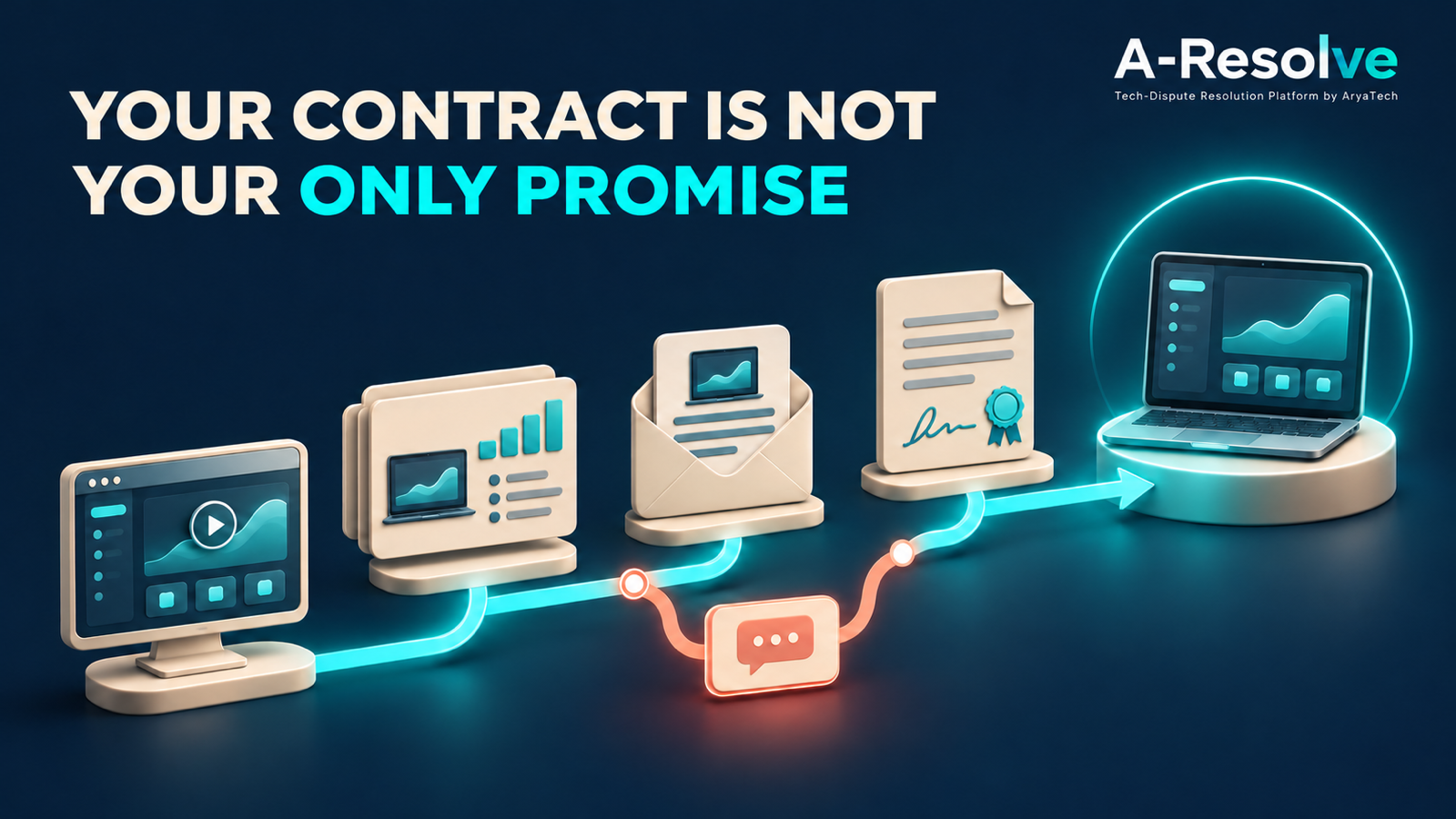
Sales messages, product capability and contractual commitments should describe the same offer.
The sentence that wins the customer today may become the evidence used against the company tomorrow.
By A-Resolve Editorial Team
Most founders know that a contract should be reviewed before it is signed. Fewer stop to review the promises made before the contract reaches the customer.
A product demonstration says the integration is seamless. A pitch deck says the platform is secure and compliant. A sales email confirms that a feature will be ready next month. A call suggests that the system can handle a particular volume, accuracy level or response time.
Each statement may help close the deal. Together, they may also create a version of the product that the customer believes it has purchased.
The signed contract may describe something narrower. It may limit the service, qualify the timetable or exclude a particular result. But when delivery begins, the customer is unlikely to compare only the clauses. The customer will compare the product with the outcome that was shown and discussed.
That is why the contract is not the company's only promise.
THE RISK BEGINS BEFORE SIGNATURE
Early-stage companies move quickly. The sales team is close to the founders, product language changes every week and demonstrations are often adapted to the needs of a specific prospect.
This flexibility can be commercially valuable. It also makes it easy for a possibility to sound like an existing capability.
The difference may be only a few words:
“The product can do this” instead of “we are testing this.”
“The integration will be ready” instead of “we expect to assess the integration.”
“The system is compliant” instead of “the system includes features that may support your compliance process.”
“The AI identifies every relevant issue” instead of “the model assists the review and requires human verification.”
The salesperson may hear enthusiasm. The customer may hear a commitment.
THE CONTRACT CANNOT ERASE THE WHOLE SALES JOURNEY
Founders sometimes assume that a carefully drafted contract will neutralise anything said earlier. That assumption is commercially dangerous even before anyone argues about the legal effect of a statement.
The customer may have internal approval based on the demonstration. Its budget may have been justified by the pitch deck. Its implementation plan may depend on the delivery date in an email. Its own commitments to management, users or investors may reflect what the sales team said.
When the product does not match that expectation, the immediate consequences can include:
1. A refusal to accept delivery or pay an invoice.
2. A demand for additional work without additional fees.
3. A request for a refund or early termination.
4. A delayed launch or failed customer project.
5. A lost renewal, negative reference or reputational problem.
6. A claim that the customer relied on an inaccurate statement.
The company may eventually have a strong contractual defence. It may still lose the customer, the revenue and weeks of founder attention.
A FAMILIAR TECHNOLOGY-SALES SCENARIO
Imagine an AI startup selling a workflow platform to a regulated business.
During the demonstration, the founder says that the system can connect to the customer's existing software, identify every high-risk record and provide a complete audit trail. The pitch deck describes enterprise-grade security. An email says the integration should be operational within six weeks.
The contract is more careful. It describes a standard subscription, makes the integration subject to technical assessment and explains that AI output requires human review.
After signature, the customer's data structure makes the integration more difficult. Some records cannot be processed in the expected way. The audit trail requires additional development. The customer says these features were the reason it selected the product.
The startup says the contract never guaranteed them.
At that point, the dispute is not just about one clause. It is about two different versions of the deal.
FIND THE PROMISE GAP BEFORE THE CUSTOMER DOES
A practical review should compare four things:
The claim: What exact result, feature, date, standard or performance level is being communicated?
The source: Does it appear in a demonstration, deck, proposal, email, message, call script, website or contract?
The operational owner: Who inside the company can confirm that the claim is accurate today?
The limit or evidence: What condition, dependency, test result or qualification must be explained so that the customer understands the real offer?
This does not require salespeople to speak like lawyers. It requires the company to use one honest and commercially effective description of the product.
If a claim cannot be confirmed by the product or delivery team, it should not be presented as a current capability. If a timetable depends on customer data, third-party access or technical testing, that dependency should be visible before signature. If an AI result has known limits, those limits should be communicated in language the buyer understands.
THE FIX IS AN OPERATING SYSTEM, NOT A DISCLAIMER
Adding a broad disclaimer to the final page of a deck will not repair a sales process that consistently creates the wrong expectation.
A better structure includes:
Approved claims: Maintain a short list of claims that the team can make confidently about features, security, integrations, performance and results.
Escalation triggers: Require product or technical confirmation before promising a custom feature, delivery date, integration, accuracy level or compliance outcome.
Deal-specific record: Record the statements that materially influenced the customer's decision and ensure the contract and implementation plan address them.
Clear ownership: Give one person responsibility for aligning the demonstration, proposal, product scope and contract before signature.
Change control: When the product or sales message changes, update the approved claims and customer materials rather than allowing old promises to circulate.
The goal is not to slow sales. It is to prevent a fast sale from becoming an expensive delivery conflict.
WHEN THE DISAGREEMENT HAS ALREADY STARTED
Not every promise dispute needs the same decision-maker.
A technical expert may need to determine whether the system meets a stated specification, whether an integration is technically possible, whether a performance threshold was achieved or whether a claimed defect is caused by the product, the customer's environment or a third party.
A mediator may help the company and customer agree a revised delivery plan, price adjustment, limited additional work, continued service or an orderly exit while preserving commercial value.
An arbitrator may be needed when the parties require a binding decision on the meaning of the agreement, payment, termination, responsibility or damages.
Starting with the final legal remedy can consume time and money while the technical and commercial questions remain unresolved. Treating every disagreement as a customer-service issue can also fail when a binding decision is necessary.
The route should match the decision required.
HOW ARYATECH AND A-RESOLVE ADDRESS THE PROBLEM
AryaTech can help technology businesses align sales claims, product capability, delivery assumptions and contractual commitments before a customer dispute develops.
When a disagreement has already emerged, A-Resolve provides connected routes for Expert Determination, mediation and arbitration. Technical performance questions can be directed to an expert. A commercial repair or exit can be explored through mediation. An unresolved legal claim can proceed to arbitration when a binding outcome is required.
The purpose is not to add procedure. It is to identify the real question early and keep a mismatch in expectations from consuming the relationship, the revenue and the founders' time.
THE QUESTION TO ASK BEFORE THE NEXT DEMONSTRATION
If the customer saved the recording, the pitch deck and the sales emails, would they all describe the same product that the contract describes?
If the answer is uncertain, the promise gap already exists. The dispute simply has not started yet.
This article provides general information and does not constitute legal advice. Product claims, sales materials, contracts and dispute procedures should be adapted to the business, transaction and applicable law.
 A-Resolve